

A shoulder belt may look like it stayed exactly where it belonged in high-speed video, but that doesn't show everything that happened between the belt and the occupant during the impact. Put a high-speed pressure sensor between the restraint and the crash-test dummy, and you can see where contact actually happened, how much pressure developed across the surface, and how that changed as the dummy moved through the crash.
That gives engineers a different type of information than accelerometers, load cells, dummy instrumentation, and cameras already used in the test. Pressure mapping doesn't replace any of those measurements. Still, it can show things they can't, especially when the question is where a restraint or vehicle surface contacted the occupant and what happened to that contact over a few milliseconds.
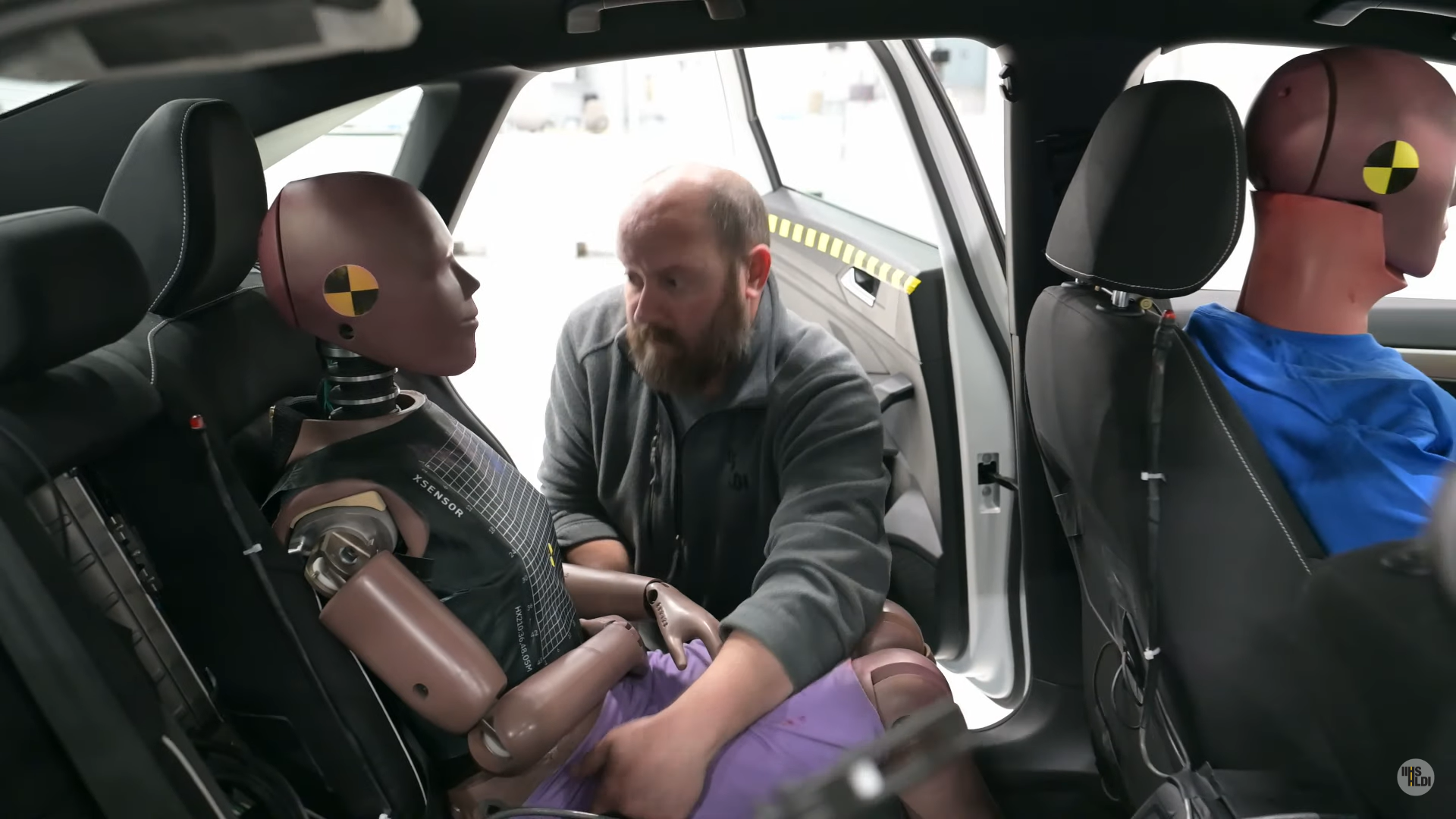
The Insurance Institute for Highway Safety (IIHS) is already using the technology this way. Its current Moderate Overlap 2.0 crash-test protocol specifies an XSENSOR HX210 high-frequency pressure mat on the rear dummy's chest to measure shoulder-belt position and pressure during the impact.
What Does Pressure Mapping Add to a Crash Test?
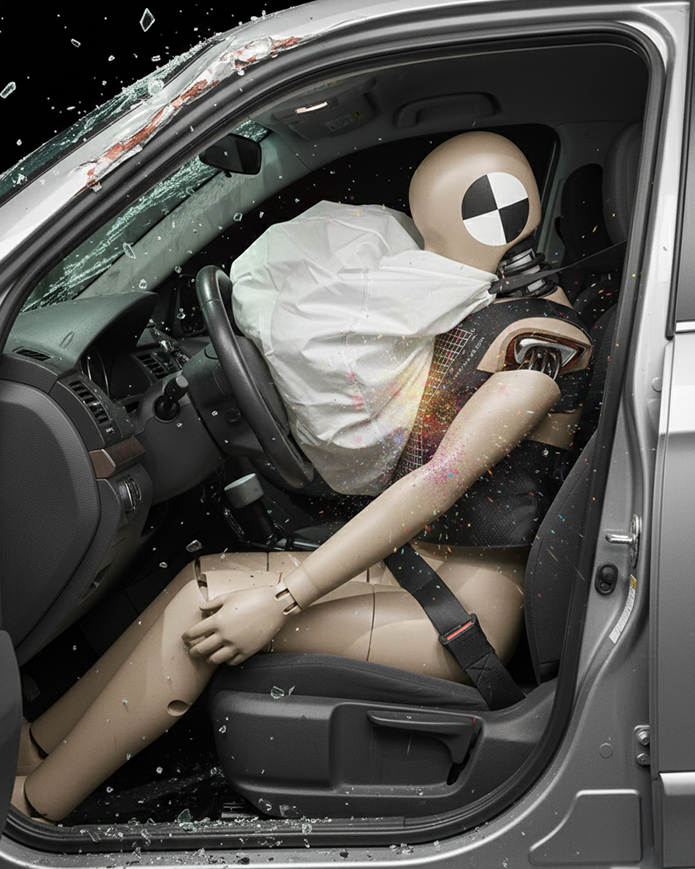
A crash-test dummy already has a lot going on inside it. Accelerometers record motion, load cells measure forces and moments, and other instrumentation helps engineers calculate the injury measures required by the test protocol.
Those measurements don't necessarily tell you how the load was spread across the surface where the dummy touched the restraint, seat, or another part of the vehicle. A load cell might tell you how much tension developed in a shoulder belt, for example, but not exactly where that belt was sitting on the chest while the dummy was moving.
Pressure mapping fills in some of that missing information. Instead of a single force value, you get a picture of the contact area and how pressure within it changes as the event unfolds.
That can be especially useful when two tests produce similar overall loads, but the contact itself is different. Maybe the belt stayed well down on the thorax in one test and moved toward the neck in the other, or maybe a seatback load concentrated into a much smaller area even though the rest of the test looked fairly similar.
What Can Pressure Mapping Measure That Video Cannot?
High-speed video is obviously important in crash testing because you can watch the dummy move, see airbags deploy, and follow major changes in occupant position. But even a very good video is still showing you the outside of the interaction.
A pressure mat under the belt shows the contact itself. You can see where the belt presses into the dummy, how wide that contact area is, which part takes more pressure, and how the pattern changes from one frame to the next. That becomes useful when movement is small or partially hidden. Even a relatively small upward shift of a belt on the chest can matter. Depending on the camera angle and everything else happening during the crash, the exact contact position may not be obvious from video alone. IIHS uses pressure data for exactly this type of measurement. Its current rating methodology calculates the rear occupant's dynamic shoulder-belt position from pressure-sensor frames and chest landmarks, which gives engineers an actual belt position rather than relying only on what the camera appears to show.
How Is Pressure Mapping Different From a Load Cell?
A load cell and a pressure mat are answering different questions. If you want to know the tension in a seat belt, a belt load cell is extremely useful, but that value doesn't tell you exactly how that force is applied across the dummy's chest.
Pressure mapping gives you the surface side of the interaction. You can see whether the belt contacts a broad part of the thorax, concentrates into a smaller section, or moves as the occupant loads the restraint. You really want both when both questions matter. The load cell tells you what is happening in the belt, while the pressure mat shows what that load looks like where the belt actually contacts the occupant. IIHS's own protocol is a good real-world example because it uses seat-belt load cells as well as the chest pressure mat. One does not replace the other.
Where Can Pressure Sensors Be Used in Occupant Testing?
The chest is an obvious place to start because of restraint interaction, but it isn't the only surface engineers may want to consider. Depending on the test, pressure sensors can be placed where the dummy contacts the seat bottom, seatback, head restraint, or another surface where knowing how the load is distributed adds something useful.
The question should really come first. If you are trying to understand shoulder-belt movement, put the measurement at the restraint interface. If you're concerned about how an occupant loads the seatback or head restraint, the sensor needs to capture that contact instead. That sounds simple, but placement matters when the impact happens in a fraction of a second. The sensor has to stay where you intended it to stay, survive the event, and give you a pressure pattern that still lines up with the part of the dummy or vehicle you thought you were measuring.
How Does IIHS Use Pressure Mapping for Belt Position?
This is probably the strongest example because it is not just a manufacturer demonstrating its own technology. IIHS specifies a high-frequency XSENSOR pressure mat incorporated into a vest on the rear H35F dummy in the Moderate Overlap 2.0 test. Before the crash, the mat is positioned relative to the dummy's landmarks. During the test, the belt leaves a changing pressure impression on the mat, and IIHS uses that data to calculate where the shoulder belt is sitting on the dummy's thorax. That matters because a belt that moves too far toward the neck is no longer loading the occupant the same way. IIHS has identified belt position as an important part of effective restraint and uses pressure-sensor data in its current dynamic belt-position measurement.
There is an interesting detail in the current 2026 methodology too. IIHS now uses an automated process to clean the pressure frames, identify connected belt-contact regions,, and calculate the belt centerline from the pressure data, showing how far this has moved beyond simply looking at a colorful pressure image after the test.
Why Does Sampling Speed Matter During an Impact?
A patient walking across a clinic gives you plenty of time, unlike a crash test. In an impact, the contact you care about may appear, move, and disappear so quickly that a low-sampling-rate pressure system can miss much of what actually happened. That is why high-speed pressure mapping is its own category. Our HX impact sensors are sampled between roughly 2,000 and 5,000 frames per second depending on the sensor and configuration, which gives engineers many pressure frames across an event that may only last a very short time.
More frames help you follow the contact rather than only seeing where it started and ended. A shoulder belt can begin in one position, load the chest, move upward, and then unload again, and the useful information is in how that whole sequence happened. The same idea applies at the seat or head restraint. A maximum pressure value tells you something, but knowing when it appeared and what the contact looked like just before and after can tell you much more about what the occupant was doing.
How Is Pressure Mapping Synchronized With Other Crash-Test Data?
Pressure data is much easier to use when it aligns with the other data collected during the crash. Engineers may want to compare a pressure frame with belt load, chest deflection, dummy acceleration, or a specific high-speed video frame, and that gets difficult quickly if the systems run on their own clocks.
A high-speed pressure system therefore needs a reliable way to trigger and synchronize acquisition with the rest of the test. Our vehicle impact system includes programmable remote triggering, allowing pressure recording to be incorporated into a repeated crash or sled-test procedure rather than started manually at an arbitrary point. Timing errors that sound tiny in normal testing can be a big deal here. If the pressure data shifts even slightly, an engineer may end up comparing belt contact from one part of the event with chest or belt-load data from another.
That doesn't make the pressure measurement wrong, but it makes the combined analysis much harder to trust. In crash work, knowing exactly when something happened can be as important as knowing how much pressure there was.
How Can Pressure Data Help Engineers Evaluate Restraint Systems and Design Changes?
Say an engineering team changes the belt geometry or modifies part of the restraint system. The next test might show similar belt loads and the video may still look reasonable, but the pressure map could show the shoulder belt now rides higher across the dummy's chest or loads a smaller area than before. Now the design change has given you another result to look at. You can compare the pressure distribution from the original test with the new one and see whether the contact moved, spread out, or became more concentrated. The IIHS example is useful again here because belt position isn't just something engineers are curious about. IIHS added the torso pressure sensor specifically to measure dynamic shoulder-belt position on the rear occupant, and its updated moderate-overlap test considers whether the belt moves too high toward the neck when judging restraint performance.
Pressure data can also help explain what you already saw elsewhere. If a load or dummy measurement changed between tests, the pressure map may show that the restraint contacted the occupant differently at the same time.
How Can Engineers Compare One Crash Test With Another?
Comparison falls apart quickly if the measurement changes every time you run the test. Sensor placement, calibration, trigger timing, and data processing all need to be consistent enough that differences between two pressure maps are more likely due to design than to measurement setup. That is especially important when the change you are looking for is small. If the belt moved only a little or pressure shifted within the same general contact area, inconsistent sensor placement can make the two tests look more different than they really were.
Our impact sensors are designed for repeatable cell-by-cell measurements and calibration stability across repeated cycles. The system also uses thin, conformable sensors because a thick or rigid sensor can change the interface it is supposed to measure.
None of that gets rid of normal crash-test variation. It just gives engineers a better chance to compare the same measurement the same way when they change the restraint, seat, geometry, or another part of the occupant-protection system.
What Are the Limits of Pressure Mapping in Crash Testing?
A pressure map can tell you a lot about contact, but it cannot tell you whether an occupant is safe on its own. Crash injury analysis still depends on dummy instrumentation, biomechanical criteria, vehicle response, restraint performance, high-speed video, and whatever measurements the applicable test requires.
The National Highway Traffic Safety Administration's (NHTSA) own vehicle research program makes that pretty obvious. Its work covers crashworthiness, biomechanics, crash-test dummy standardization, and a range of vehicle and occupant-protection measurements because no single sensor describes everything that happens to an occupant during a crash.
Pressure must also be interpreted as contact data. A high-pressure area may matter, but the number alone doesn't automatically predict injury without the surrounding biomechanical information. The sensor itself can create problems if the wrong one is used. Pressure range, sensor response, placement, and conformability all matter, and once a sensor saturates or moves away from the surface you thought you were measuring, having thousands of frames per second will not rescue the test.
What Should Engineers Look for in a High-Speed Pressure Mapping System?
Start with whether the system can capture the event you actually care about. Sampling rate matters for short impacts, but so do pressure range, sensor response, and enough sensing points across the contact area. The sensor also needs to fit the surface without getting in the way. A thin mat that conforms to the dummy or restraint interface is much more useful than something that changes the contact geometry just by being there.
Then look at the less glamorous things. Triggering, synchronization, calibration stability, and repeatability become critical when you start comparing a series of crash or sled tests rather than collecting one impressive-looking pressure map. Ruggedness matters too. Automotive impact equipment gets mounted on sleds, installed on dummies, and subjected to tests that aren't exactly gentle, so equipment that works beautifully on a bench but becomes unreliable during repeated impact testing isn't much help.
What Else Should Engineers Know About Crash-Test Pressure Mapping?
Can Pressure Mapping Replace Crash-Test Dummy Instrumentation?
No. Pressure mapping measures surface contact and pressure distribution, while the dummy's other sensors measure acceleration, forces, moments, and deformation used in different parts of occupant-protection analysis. Combine the measurements, and you get more context. Trying to make the pressure mat do the job of every other crash-test sensor would throw away most of what makes the full instrumentation package useful.
What Sampling Rate Is Needed for Impact Testing?
There isn't one number that makes sense for every impact test. The system needs to sample quickly enough to resolve the contact changes happening during the event, which is why XSENSOR's high-speed impact sensors operate in the roughly 2,000 to 5,000 frames-per-second range depending on configuration. The test itself still decides what you need. A short, violent contact event may require a different setup than a slower-loading event, even though both fall under vehicle safety testing.
Can Pressure Mats Measure Seat-Belt Position?
Yes. IIHS currently uses a high-frequency pressure mat on the rear occupant dummy's chest in its Moderate Overlap 2.0 test to measure dynamic shoulder-belt position and pressure.
The pressure impression relates to landmarks on the dummy so that the belt centerline can be located on the thorax during the crash. That gives IIHS a dynamic belt-position measurement rather than relying on video alone.
Where Are Pressure Sensors Placed on an ATD?
That depends on what the engineer wants to measure. Restraint testing may put a sensor across the chest, while another project could use pressure sensors at the seatback, seat bottom, head restraint, or another contact surface. Placement needs to follow the question. Putting a pressure mat somewhere just because there's room for it won't produce useful occupant-protection data unless that contact relates to the problem being investigated.
Can Pressure Data Be Synchronized With High-Speed Crash-Test Acquisition?
Yes. High-speed pressure systems can be triggered as part of the crash or sled-test acquisition so pressure frames can be compared with the rest of the instrumentation and high-speed video.
That synchronization lets engineers ask useful questions, such as where the belt was sitting when a particular chest response occurred, instead of trying to line up two recordings by eye after the fact.
